1 FREE CERP in celebration of “Happy IBCLC Day!”

happy ibclc dayMarch 4 marks the celebration of Happy IBCLC day! For those of you who don’t know what an IBCLC is – the acronym stands for an International Board Certified Lactation Consultant.

In efforts to say thank you to all of the IBCLCs out there who have worked tirelessly to help breastfeeding families around the world and to show its gratitude, the GOLD Lactation 2014 Conference is offering access to a FREE presentation titled, “Demystifying Professional Certification Examination Development” presented by by Sara Lake and Rachelle Lessen of the International Board of Lactation Consultant Examiners (IBLCE). This presentation is not only free but it gives you the opportunity to earn 1 FREE CERP as well.

Visit the Gold Conferences’ Online Learning Continuing Education page here for access to the FREE presentation. The presentation is 1 hour in length and accessible for 24/7 for 2 weeks. Don’t forget to claim your FREE CERP!

If you’re interested in accessing other presentations offered through the Gold Online Lactation Conference 2014, you can find more information here. Galactablog and all of its followers would like to extend a gracious thank you to the Gold Online Conference this year for providing such an incredible opportunity and access. Thank you!

If you have a Twitter account, don’t forget to tweet #HappyIBCLCday!


How Can Lactation Professionals Help Make Child Care Centers Breastfeeding-Friendly?

edited stormy cover pic

Guest Post by Stormy Miller, CLC

February 27, 2015

Why should daycares, nurseries and child care centers support their breastfeeding families and create a breastfeeding-friendly site?

In short, the payoff is significant.

Child Care Centers can see savings and benefits from breastfeeding in areas like:

  • Better daily attendancebreastfeeding_welcome_here_stickers
  • Less spit-up, reflux and GERD
  • Less offensive diaper smell
  • Healthier newborns, infants and children
  • Public image boost for center
  • Builds trust and communication with parents
  • Encourages centers and its employees to be up-to-date on current breastfeeding information and practices related to child care and development
  • Centers under the USDA Child Nutrition Program (or similar programs) may get reimbursed if parents do not use the provided food (as they are instead using expressed breast milk)

Having a breastfeeding-friendly daycare, nursery or child care center will not only help support the mother in reaching her breastfeeding goals, but it will also increase breastfeeding rates and lead to healthier people. Hopefully, this in turn will help reach the Healthy People 2020 goals.

How do we create a breastfeeding-friendly center?

  • Education is key! Staff and employees not only need to know the benefits of breast milk but also how to bottle feed breastfed babies (called paced bottle feeding) and how to store and handle breast milk (more on this below). They also need to know that from 1 – 6 months of age, breastfed babies do not need increased quantities of milk because breast milk changes composition to meet infants’ needs – so unlike formula, volume does not increase. Many assume that as babies grow, they need greater quantities of milk and this is not true in the case of breastfed babies.
  • Paced Bottle Feeding – This is a method of bottle feeding that mimics breastfeeding. The baby controls the feeding, just like at the breast, which is not only healthier for the infant’s digestive tract, but it helps protect the breastfeeding relationship. See here for videos on how to do Paced Bottle Feeding.

  • Feed on demand – Watch for hunger cues instead of scheduled feedings. In fact, most infants will begin to put themselves on a general schedule (e.g. 3 oz every 3 hours).
  • Develop a communication plan with parents – What should be done if breast milk is gone? Does mom want to bring in an emergency freezer stash that is clearly labeled for cases like this? When should this freezer bag be de-thawed and does mom want to be contacted in this case? What does mom want done if baby is acting hungry and she will not arrive for another hour? Have a clear plan and be aware of both parties’ expectations.
  • Do not give any bottle within 1 hour of mom’s arrival if possible– This way baby will be ready for mom (as long as this is outlined in communication plan).
  • Know proper breast milk storage and handing guidelines, including  how to properly thaw and warm up breast milk.– see here and here and here.
    • Guideline charts are great to print and put on all of the refrigerators!
  • milk labelsEstablish proper and correct labeling procedures in place for breast milk. Ensure  all staff understand protocol and labeling techniques and that parents are educated on labeling protocol as well.
  • Ask the mother to bring her milk in small amounts (2-3oz. in each bag) to avoid unnecessary wastage – especially if regulations require throwing out bottles that are not finished within 1 hour.
  • Offer to keep breast milk in the mother’s cooler, if her baby has not finished it within the 1 hour rule.
  • Baby-wear – wear infants in wraps, slings, etc. Studies show baby-wearing keeps babies calmer, less colicky, promotes physical development, increases trust and attachment and promotes breastfeeding; in addition to helping employees multi-task with multiple children. See here and here and here. Some cities, counties and or state regulating agencies do not allow baby-wearing, so always check with your regulatory agency first to ensure you are abiding by current regulations.
  • Have free breastfeeding materials and how-to guides available for caregivers here and breastfeeding families here (hard copy), here (electronic) and here readily available and accessible. These are just some examples of what’s available.
  • Create a community breastfeeding resource guide – let parents and caregivers know what type of help is available in their own communities. This can include local breastfeeding support groups, WIC offices, lactation consultants, breastfeeding peer counselors, breastfeeding classes, Baby Cafés, etc.

    Click on book!

  • Normalize breast feeding for all – infants, children, parents, employees, etc. Have children’s books that discuss breastfeeding or show illustrations of breastfeeding. This demonstrates that nursing is the natural and healthiest way of feeding. Some examples available: Mama’s Milk, Nursies When the Sun Shines, The Mystery of the Breast, We Like to Nurse, We Like to Nurse Too, Mommy Breastfeeds My Baby BrotherMichele: The Nursing Toddler – A Story about Sharing Love

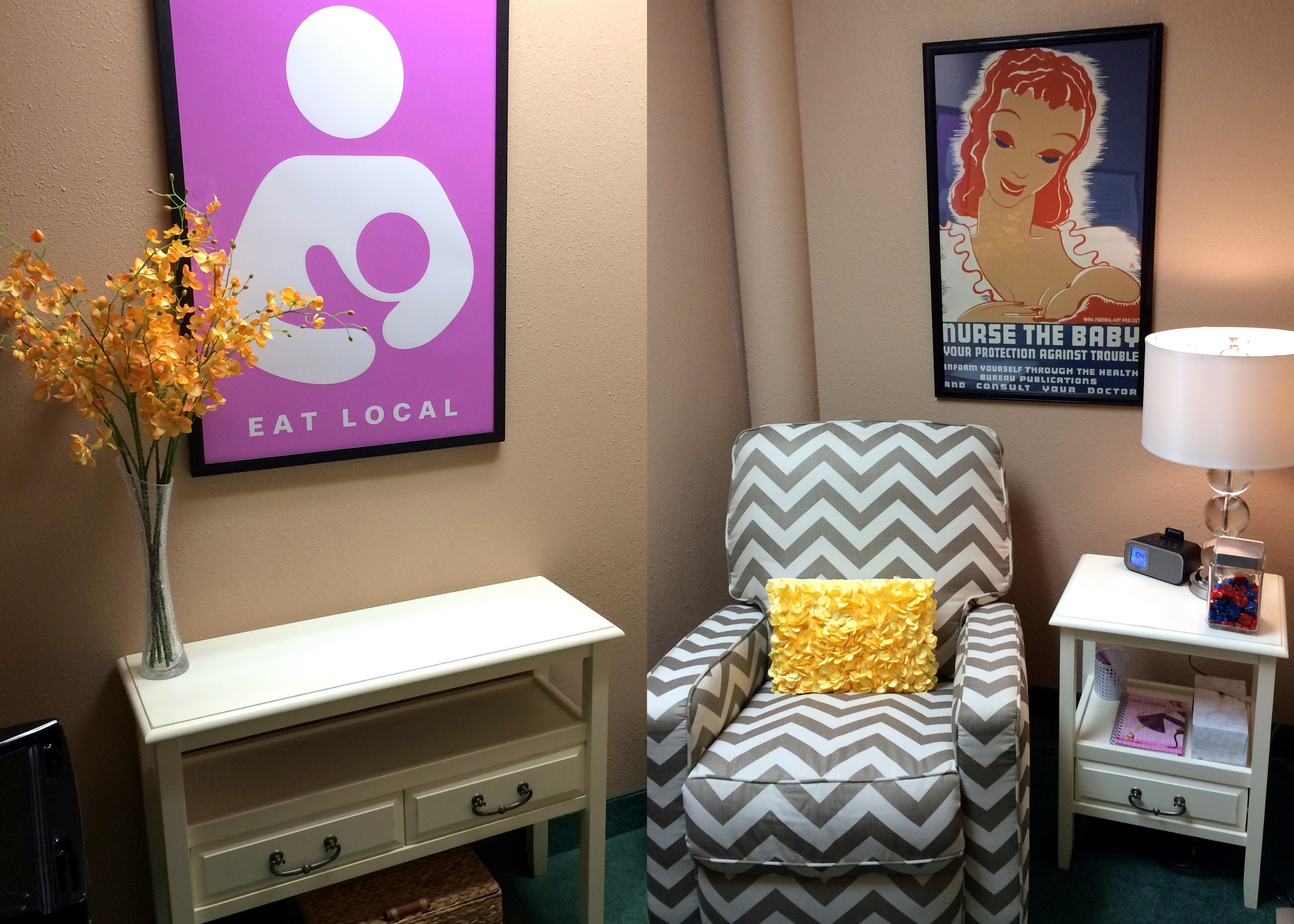
 Last but not least, provide a comfortable, practical space for pumping and nursing – for both nursing mothers, staff and employees. Many mothers will nurse at drop-off and, if their work allows, will pop in during the day to nurse their baby. What can be included in a pumping/nursing space? Here are some ideas: 

ACES Lactation Room, Peoria, AZ http://austincenters.com/

Lactation Room at Austin Centers for Exceptional Students (ACES) Peoria, AZ http://austincenters.com/

  • A room with a locking door, a comfortable chair – perhaps with a footstool, outlet for the pump, table to set the pump on, a mini fridge or fridge access, a sink (or access to one), a CD player or I-pod dock for relaxing music and mini heater for cold rooms can also be beneficial.
  • If possible, a microwave for sanitizing (with the microwave bags). Hand sanitizer and/or sanitizing wipes.
  • Even better – providing extra storage bags and bottles for milk collection in case the mother forgets hers at home.
  • If a workplace has multiple pumpers, they could consider investing in and supplying a hospital-grade multi-user pump. This will enable mothers and staff to pump efficiently and effectively – thus saving time and ensuring they maintain their milk supply. A win-win for all!


If you would like to write a guest post or collaborate on a post for Galactablog, please contact me with your ideas! I am open, flexible and very interested in helping you publish anything lactation-related.

FREE Webcast with 1 FREE L-CERP/CEU: “Supporting Breastfeeding in the Presence of Tongue Tie/Lip Tie”

cmtc logo

Title: “Supporting Breastfeeding in the Presence of Tongue Tie/Lip Tie”

Presenter: Dee Kassing, BS, MLS, IBCLC, RLC

Date: Tuesday, March 3, 2015

Time: 08:30 AM – 10:30AM CST

Sponsors: The Illinois Department of Human Services & the Springfield Urban League Community Health Training Center

GOAL: Participants will be able to provide effective breastfeeding support by learning to recognize the symptoms that may indicate the presence of tongue and or lip tie, and describe suggested feeding plans that may help maintain a breastfeeding relationship.   

OBJECTIVES:

Following the webcast teleconference, participants will be able to:

  • List at least three symptoms present in a breastfeeding mother that may indicate the presence of a tongue tie and/or lip tie in her baby.
  • List at least three symptoms present in a breastfeeding baby that may indicate that baby has a tongue tie and/or lip tie.
  • Describe at least two feeding plans that may help to maintain a breastfeeding relationship until a tongue tie and/or lip tie can be released.

Power Point Presentation Handout & Presentation Resources

Click here to access the registration form

Click here to access past webcasts, presentation power point handouts and resources.

Curious about the L-CERP & CEUs? According to the registration form: “In order to receive continuing education credit for IBCLC, RN and RD, you must view the webcast and complete the required evaluation by March 4, 2015 at 11:59PM CST. This webcast meets a portion of the hourly requirement for CLC recertification. You will receive a certificate of completion.”

To view past satellite and webcast teleconference handouts and videos, click here.

If you miss the original view date and would still like to obtain the Certificate of Completion – all you need to do is to complete the broadcast evaluation. Send your request to ccurry@springfieldul.org or rpondexter@springfieldul.org.


Lactation Program Review: Lactation Education Resources’ (LER) Lactation Consultant Training Program & Breastfeeding Specialist Certificate

Lactation Program Review: 

Lactation Education Resources (LER)

Lactation Consultant Training Program

with Breastfeeding Specialist Certificate 

Reviewer: Dianna Castillo

February 22, 2015

Year enrolled in Program: 2013-2014

How long did it take you to complete the program? I completed the program in 6 months (but LER gives you 1 year to finish)

Certification or Certificate Offered – Breastfeeding Specialist certificate

Delivery of Program – Completely online

Name of Instructor – Vergie Hughes

Books & Materials Required – The textbook Breastfeeding and Human Lactation, 5th Ed is required by LER.

Cost of Program (Including books, materials, application fees, etc.) – $895 + book, so about $1,000

# of L-CERPs, Nursing Contact Hours, CEUs, CPEs, etc. offered – 90 L-CERPs, 90 Nursing Contact Hours and 90 CPE Level II.

Do this program’s hours meet partial or full requirements for the IBCLC exam’s lactation specific training requirement? Yes, it meets the full 90 hour IBCLC lactation education requirement.

What did you like about the program?

  • The course covered almost everything I needed.
  • I was able to listen to the lectures several times to catch things I may have missed the first time.
  • I also printed the power points with the lecture slides to look over the material and take notes while listening to the lectures.

How rigorous/time consuming did you find the program?

I have a full time job as an RN and a family.  Looking back, I realized I waited too long to get started.  I should have given myself the full year that LER allows. I was cramming at 6 months considering my busy schedule.

Would you recommend this program to others?  Yes.  It is a wonderful program.  It prepared me very well.

Knowing what you know now, would you take this program again? Yes, definitely!

Do you feel the course and/or certification helped you obtain your goals? Yes.  Everything was easily accessed from the Internet right from the program.

Does your program/credential require you to recertify? If so, how long does the credential last and what is required to recertify? No, we don’t have to recertify. The Breastfeeding Specialist Certificate granted by LER is good for 5 years.

Would you like to write a review of a Lactation Training Program that you’ve taken? If so, don’t be shy! You can access the review form directly from Galactablog. Or online via Google Forms here.

See here for more information on LER’s lactation training programs, along with comparison of similar lactation training programs.

**Disclaimer – The views and opinions expressed in this review are those of the author and do not necessarily reflect those of Galactablog. It’s important to note that these views are not the only source of information about this particular lactation training program.

Lactation Program Review: Lactation Educator Training through CAPPA

Lactation Program Review: 

Lactation Educator 20 hour Training

through  CAPPA

 Reviewer: Keva West

        February 21, 2015

How long did it take you to complete the program? 3 days

What year did you complete the program? 2014

Certification or Certificate Offered – Lactation Educator

Delivery of Program – In-person 20 hour Lactation Educator Training over a period of 3 days

CAPPA’s current Lactation Educator Training locations, times and dates

Books & Materials Required – The initial three-day training provided a manual and handouts that corresponded with the PowerPoint.

Cost of Program (Including books, materials, application fees, etc.) – $400

# of L-CERPs, Nursing Contact Hours, CEUs, CPEs, etc. offered – 21.5 L-CERPs (guaranteed through 2015).

Do this program’s hours meet partial or full requirements for the IBCLC exam’s lactation specific training requirement?

Yes, partial (21.25 hours).

If yes, how many hours of lactation specific training are counted for the IBCLC exam?

It counts for 21.25 hours towards the 90 hour IBCLC exam lactation education requirement.

Name of trainer(s): Christy Jo Hendricks

What did you like about the program?

  • The program and training makes you passionate about breastfeeding.
  • The material is easy to understand.
  • The instructor made everything come alive and made it very exciting to those interested in the field of lactation.

What did you dislike about the program?

The three days of training went by too fast. We had a such fun in Christy’s training.

What did you change about the program?

  • Maybe add an extra day of training
  • I don’t really have any complaints so far

How rigorous/time consuming did you find the program?

I am a stay-at-home wife, so I found it worked for me.

Would you recommend this program to others?

Yes, I would recommend it to anyone who has an interest in become a Lactation Educator.

Knowing what you know now, would you take this program again? 

I am actually furthering my education and training by enrolling in the CLE course through CAPPA Academy in order to become a Certified Lactation Educator (CLE). See here for the scope of practice for a CLE through CAPPA. I would definitely take this course because if you’re passionate about breastfeeding, then CAPPA is the way to go. In my opinion, learning has never been so much fun! I am happy that I am finally obtaining an education and training that I really love.

Do you feel the course and/or certification helped you obtain your goals?

I feel it has. I am using what I have learned to help empower women to breastfeed. So yes, that’s a reward for me.

Additional Comments?

  • If you find that your passion is lactation, I suggest you try to schedule a training with Christy Jo Hendricks because she is awesome and empowers you to make a difference!

Does your program/credential require you to recertify? If so, how long does the credential last and what is required to recertify? Once I decide to certify as a CLE, my CLE credential is good for 3 years. At that time, I will need 15 CERPs to recertify – all of which can be earned at the annual conference, which is FREE to all CAPPA members. You can read more on CAPPA’s recertification process here.

Would you like to write a review of a Lactation Training Program that you’ve taken? If so, don’t be shy! You can access the review form directly from Galactablog. Or directly online via Google Forms here.

**Disclaimer – The views and opinions expressed in this review are those of the author and do not necessarily reflect those of Galactablog. It’s also important to note that these views are not the only source of information about this particular lactation training program. See here for more program details on CAPPA, along with comparison of similar Lactation Training Programs. If you’re interested in Lactation Training Programs that offer a clinical practice component, see here.

Tongue Tie Educational Video Teaching Tip

This incredibly useful, creative and educational video tip by MaryAnn O’Hara, MD, MPH is excellent for teaching lactation professionals, aspiring lactation specialists, breastfeeding peer counselors and even parents HOW to understand (and teach) tongue tie  what is is, how it can affect breastfeeding and what clipping entails. Dr. O’Hara’s approach is innovative, applicable and brilliant. I must say so myself, it’s quite fun to do as well. But I worn you, it takes a bit of practice, so practice at home in front of a mirror first!

I’d like to note that I heard about this video via Lisa Green, DNP, RN, who mentioned it during one of her lectures that was a part of ASU’s Clinical Lactation Management program.

Do you have any educational videos in mind that you’d like to share? Perhaps one that helps better illustrate a concept or another that has incredible eye-catching graphics. If it relates to lactation, contact Galactablog with your ideas! Also, check out Galactablog’s Youtube Video channel. Breastfeeding-related topics are categorized and arranged as different playlists. Again, if you’d like me to add any videos you find particularly effective, don’t be shy, let me know!

Two Free iMothering February Talks Available

iMothering is offering 2 FREE talks this month – access available until February 28, 2015.

cecily newCecily Harkins talk: “Birth Order.” Click here for access.

“February’s featured TALK is by Cecily Harkins, who has 8 children of her own and 16 grandchildren! This talk, Birth Order, will cover the basic characteristics of each Birth order- First Born or Only, Middle, Last Born.”


Lysa-ParkeriMothering always offers a bonus talk every month!

February’s talk features Lysa Parker’s talk: “Empathy: The Key to Creating a Compassionate World.”

Click here for access.

Don’t forget to join iMother’s mailing list so you don’t miss out on announcements and updates of new talks available!

Free Breastfeeding Tutorial for Pharmacists

This incredible free resource was shared with me via Galactablog’s Facebook group.  Recommended for pharmacists, pharmacy technicians, nurses, medical students, physicians, ob/gyns, pediatricians and of course, lactation professionals looking to be more versed in the medicalized aspects of lactation.

northweastern

Presents a Free Breastfeeding Tutorial for Pharmacists

Expanding a Pharmacist’s Role in Breastfeeding:

Continuing Pharmacy Education (CPE) Online Tutorial

Module 1: Breastfeeding Background

Module 2: Strategies to Improve Breastfeeding Practices

Module 3: Medications and Breastfeeding

Module 4: The Role of the Pharmacist

Objectives

Post-Test

References


Take advantage of this free training. Please feel free to share widely! Many breastfeeding mothers are told to “pump and dump” or to wean when they don’t have to. Educate yourself. Knowledge = Power! If you have any free resources that you’d like to share, don’t hesitate to contact Galactablog.

Free Breastfeeding Tips & Guide Brochures by LLLI

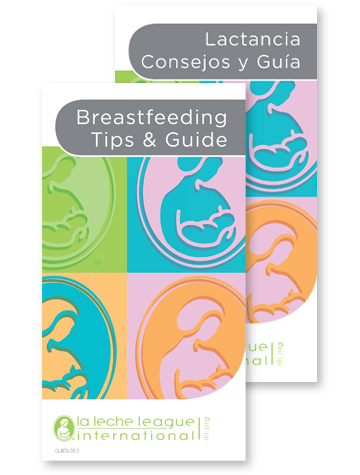
bftipsandguide_360x475La Leche League International (LLLI) is offering pocket-sized Breastfeeding Tips & Guide booklets for free. You can order as many as you like, you just pay a flat $5 shipping rate (this shipping rate is valid in the USA, I’m not sure about foreign shipping rates). They are available in English and Spanish and you can order them here. Just a tip, they come as singles, so make sure if you want 25, 50, 100, etc. that you clarify the amount you want when ordering. You put quantity you want in your cart but aren’t charged anything but shipping at the end.

These little booklets are great to hand out at breastfeeding/baby fairs, prenatal and breastfeeding support groups or classes, maternity wards, clinics and pediatrician offices or even your private lactation practice. LLLI has granted its permission for the free distribution for the booklets (meaning: don’t charge money for them!). 

Check out an electronic view so you can see what topics the booklet addresses.


Are you aware of any other free breastfeeding brochures or booklets available? If so, please share them with me through my contact form or via Galactablog’s Facebook group.

Lactation Program Review: Healthy Children’s Lactation Counselor Training Course & CLC Certification

Lactation Program Review: 

Healthy Children’s

Certified Lactation Counselor Certificate Training Program

By Anonymous

February 6, 2015

What year did you enroll in the program? 2013

How long did it take you to complete the program? 5 days

Certification or Certificate Offered – Certified Lactation Counselor (CLC)

Delivery of Program – In-person

Books & Materials Required – The Pocket Guide for Lactation Management by Karin Cadwell, 2nd edition (can be purchased on Amazon from about $25-$35).

Cost of Program (Including books, materials, application fees, etc.) – I paid $575 course + $37 book = $612 total

# of L-CERPs, Nursing Contact Hours, CEUs, CPEs, etc. offered – 45 Nursing contact hours, L-CERPs, CPEs; 4.5 CEUs for CNMs

Do this program’s hours meet partial or full requirements for the IBCLC exam’s lactation specific training requirement? Yes, partial (45 hours)

What did you like about the program?

  • The program taught the hospital nurses in my training class how hospital policies impede basic lactation – particularly the separation of mother and baby.

What did you dislike about the program?

  • I learned much more during my training as a La Leche League Leader.
  • The instructors refused to teach Reverse Pressure Softening as a way to reduce engorgement.
  • They also taught that babies can be sleep trained after 4 months, per the “notebook” we were given on the first day of class, despite the evidence of the damage that sleep training causes to babies’ neurological development and to breastfeeding.
  • The handouts we were encouraged to purchase base supplementation and baby weight on formula-fed babies, used outdated studies from the 1980s. The lack of up-to-date information was extremely frustrating, especially since the training workbook said 2013-2014.
  • The worst part is, if I hadn’t kept speaking up in class, this would have meant a whole class full of new CLCs was giving outdated information and recommendations as “evidence-based” support to new families.

How rigorous/time consuming did you find the program?

It’s a training class given from 8:15am to 4:30pm for 4 days and ends after the exam on the 5th day. Someone working full-time or with a young child at home would have difficulty unless they used vacation days and hired babysitters. I took the class because my son started nursery school and was able to stay till 5pm that week.

Would you recommend this program to others?

  • Not really – it doesn’t provide enough accurate information.
  • The workbook used in class discussed supplementing breast milk based on calculations for formula.
  • The instructors tried to minimize the tremendous difference between CLC and IBCLC, which requires twice the lactation hours, hundreds of hours of clinical and practical experience and 14 health science subjects before the applicant can even apply to sit for the IBCLC the exam. See here for Preparing for the IBCLC Certification.

Knowing what you know now, would you take this program again? 

No. It was incredibly frustrating. I’m astonished that the IBLCE grants 45 CERPs for taking it.

Do you feel the course and/or certification helped you obtain your goals?

  • If the only goal is to have some letters after your name that lets you buy insurance and work, then yes.
  • If the goal is to learn current evidence-based information, then no. I would recommend investing in GOLD Lactation, iLactation, La Leche League (LLL) and local Breastfeeding Coalition Conferences (which are available all across the nation), which is how I earned more than 45 CERPs towards the 90 hour lactation requirement for the IBCLC certification I’m working toward.

Does your program/credential require you to recertify? If so, how long does the credential last and what is required to recertify? My CLC credential lasts is good for 3 years. Recertification takes 18 hours of continuing education.

Would you like to write a review of a Lactation Training Program that you’ve taken? If so, don’t be shy! You can access the review form directly from Galactablog. Or online via Google Forms here.

**Disclaimer – The views and opinions expressed in this review are those of the author and do not necessarily reflect those of Galactablog. It’s also important to note that these views are not the only source of information about this particular lactation training program. See here for similar Lactation Training Programs. If you’re interested in Lactation Training Programs that offer a clinical practice component, see here.