Lactation Program Review: Certified Lactation Educator (CLE) Training through CAPPA

Lactation Program Review: 

Lactation Educator Training 

by CAPPA

 Reviewer: Christine Zell

        January 31, 2015

How long did it take you to complete the program? 3 days

What year did you complete the program? 2012

Certification or Certificate Offered – Lactation Educator

Delivery of Program – In-person 20 hour Lactation Educator Training over a period of 3 days

CAPPA’s current Lactation Educator Training locations, times and dates

Books & Materials Required – The initial three-day training provided a manual and handouts that corresponded with the PowerPoint.

Cost of Program (Including books, materials, application fees, etc.) – $450

# of L-CERPs, Nursing Contact Hours, CEUs, CPEs, etc. offered – 21.5 L-CERPs (guaranteed through 2015).

Do this program’s hours meet partial or full requirements for the IBCLC exam’s lactation specific training requirement?

Yes, partial (21.25 hours).

If yes, how many hours of lactation specific training are counted for the IBCLC exam?

It counts for 21.25 hours towards the 90 hour IBCLC exam lactation education requirement.

Name of trainer(s): Christy Jo Hendricks

What did you like about the program?

  • Christy is AMAZING! She offers a wealth of information and knowledge, tons of hands on activities, and has a true heart for what she does.

What did you dislike about the program?

There was nothing that I disliked about the program.

How rigorous/time consuming did you find the program?

Since it is a 3 day training, it was easy to work my schedule around this.

Would you recommend this program to others?

I highly recommend this program to others, and I do so very frequently.

Knowing what you know now, would you take this program again? 

I have to take the program again – just for fun!

Do you feel the course and/or certification helped you obtain your goals?

Absolutely. Although going through the training too additional time and expense, being a Lactation Educator has helped me in my birth business. I have families who have chosen to hire me as their doula solely because of my extra training and knowledge in breastfeeding. I also teach breastfeeding classes that have been getting great reviews.

Additional Comments?

Christy is an amazing woman. If you ever have the opportunity to take her training class, you won’t be sorry! It is worth every penny and more. On top of this, more than likely, you will also make a life long friend out of the experience as well.

Does your program/credential require you to recertify? If so, how long does the credential last and what is required to recertify? No, because I didn’t certify through CAPPA Academy. But if I did certify, recertification is required every 3 years. Recertification requires 15 CERPs – all of which can be earned at the annual conference, which is FREE to all CAPPA members. You can read more on CAPPA’s recertification process here.

Would you like to write a review of a Lactation Training Program that you’ve taken? If so, don’t be shy! You can access the review form directly from Galactablog. Or directly online via Google Forms here.

**Disclaimer – The views and opinions expressed in this review are those of the author and do not necessarily reflect those of Galactablog. It’s also important to note that these views are not the only source of information about this particular lactation training program. See here for more program details on the CLE Training Program, along with comparison of similar Lactation Training Programs. If you’re interested in Lactation Training Programs that offer a clinical practice component, see here.

Guest Post: DIY Mouth for a Soft Baby Doll by Tova Ovits

DIY Mouth for a Soft Baby Doll

Guest post by Tova Ovits, IBCLC at FirstLatch.com

The First Latch teaches prenatal Breastfeeding 101 classes at a local birthing center that provided expensive plastic dolls with awkwardly twisted legs and necks. The rigid dolls were not helpful for demonstrating breastfeeding positions, and were more useful for demonstrating the need to get therapy for torticollis. When I saw a YouTube video of IKEA dolls that were weighted, I had to hack my own dolls and figured out how to add an open mouth and tongue. The new mouth opens widely enough to demonstrate a nipple tilt or breast sandwich with a crocheted demo breast.

IKEA hack for TT doll

IKEA’s LEKKAMRAT soft Caucasian, Asian, and black dolls cost about $10 each. Their arms and legs rotate at the shoulder and thigh, allowing the “baby” to hug mom’s breast. Because I hacked the dolls in the springtime and stretchy one-size-fits-all winter gloves weren’t available, I used 2 fingers of a stretchy shower glove from the dollar store for each mouth and tongue.

Step 1: Cut 2 fingers off the stretchy glove and place one finger inside the other, with the fingertip sticking out and the cut end inside the other fingertip. The inner finger is the tongue inside the outer finger’s mouth. The cut edges of the outer finger will be folded in to create the new lips.

Step 2: Carefully cut open the doll’s embroidered mouth. Cut a little bit more than the width of the mouth, to allow it to open wider. Use your finger to separate the top and bottom of the mouth and press the embroidered lips into the hole to support the new mouth.

Step 3: Insert the new mouth & tongue (tucked glove fingers) into the hole you created. Use your finger to push it in deeply, making sure that the tongue (glove fingertip) lies flat inside the mouth (cut edge of the glove finger). Extend the edges of the new mouth to cover the outer edges of the doll’s embroidered lips.

Step 4: Fold the edges of the glove against the doll’s face, so the cut end doesn’t unravel, and sew the folded edge along the outer edge of the doll’s (embroidered) lips. Tack the corners of the new lips upward, to create a smile. Sew a philtrum into the top lip by tacking down the top center.

Step 5 (optional): To demonstrate tongue tie, tie a knot at the end of your thread and insert your sewing needle from the doll’s chin into the doll’s mouth, then tack the tongue down through the chin. Pull the knot down, so the thread has room to let the tongue elevate and extend, and knot the other end of the thread. The knots let you pull the tongue back down; hold them tightly to show how a tie keeps the tongue from moving properly.

To weight the doll after completing the mouth, carefully open the seams along the neck/back and arms and legs. I used florist sand (from IKEA) in some of my dolls, and organic cedar chips (kitty litter!) in others. I put the weight material into zip top snack bags or sandwich bags and carefully stuffed the bags into the holes in the doll, then sewed the seams shut. They weigh between 2 and 4 pounds when stuffed. I carry a lightweight doll in my bag for home visits (only the head is weighted, to allow the doll to “look up” to latch). We give heavier dolls to give the pregnant couples in our Breastfeeding 101 classes. You can make your doll as heavy as you want by adding more or less weighting material. 


ikea dolls

Tova, this is an absolutely brilliant, affordable, easy option that is helpful and useful in so many ways. Thank you so much for your willingness to share with us. You have no idea how many breastfeeding families around the world will be helped due to your creativity. Do you have a helpful, DYI solution that you’ve “MacGyvered” or hacked to make a product that can help breastfeeding families? If so, don’t be shy! Please share it with Galactablog!

Lactation Program Review: Lactation Education Resources (LER) Lactation Consultant Training Program & Breastfeeding Specialist Certificate

Lactation Program Review: 

Lactation Education Resources (LER)

Lactation Consultant Training Program

with Breastfeeding Specialist Certificate 

Reviewer: Ericka, RN, IBCLC

January 28, 2015

Year enrolled in Program: 2013-2014

How long did it take you to complete the program? Approximately 6-8 months (but I took a very casual approach)

Certification or Certificate Offered – Breastfeeding Specialist certificate

Delivery of Program – Completely online

Name of Instructor – Vergie Hughes

Books & Materials Required – The textbook Breastfeeding and Human Lactation, 5th Ed is required by LER. In my opinion, Core Curriculum For Lactation Consultant Practice and Breastfeeding Atlas were helpful as well.

Cost of Program (Including books, materials, application fees, etc.) – $895

# of L-CERPs, Nursing Contact Hours, CEUs, CPEs, etc. offered – 90 L-CERPs, 90 Nursing Contact Hours and 90 CPE Level II.

Do this program’s hours meet partial or full requirements for the IBCLC exam’s lactation specific training requirement?

Yes, it meets the full 90 hour IBCLC lactation education requirement.

What did you like about the program?

  • The program was very well organized
  • The instructors were extremely responsive
  • I felt very prepared for the IBCLE

What would you change about the program?

It would have been great to be able to listen to some of the presentations as podcasts while driving. You have to sit at the computer and click next slide. I am sure this is to make sure you actually completed the course though.

How rigorous/time consuming did you find the program?

I usually worked on the classes during my lunch hour at work. My boss also allowed me to do slides in between clients at work. I was working full-time but managed to finish in 6-8 months (working on the program casually).

Would you recommend this program to others? Most certainly!

Knowing what you know now, would you take this program again? Yes!

Do you feel the course and/or certification helped you obtain your goals? Yes, I felt well prepared.

Does your program/credential require you to recertify? If so, how long does the credential last and what is required to recertify? No, we don’t have to recertify.

Would you like to write a review of a Lactation Training Program that you’ve taken? If so, don’t be shy! You can access the review form directly from Galactablog. Or directly online via Google Forms here.

See here for more information on LER’s lactation training programs, along with comparison of similar lactation training programs.

**Disclaimer – The views and opinions expressed in this review are those of the author and do not necessarily reflect those of Galactablog. It’s important to note that these views are not the only source of information about this particular lactation training program.

Lactation Program Review: Certified Lactation Educator (CLE) Training through CAPPA

Lactation Program Review: 

Certified Lactation Educator (CLE) Training Program

through  CAPPA Academy

 Reviewer: Sejal Fichadia 

        January 26, 2015

How long did it take you to complete the program? I’m still working on it!

Certification or Certificate Offered Upon Completion – Certified Lactation Educator (CLE)

Scope of practice for a Certified Lactation Educator (CLE)

Delivery of Program – In-person 20 hour Lactation Educator Training over a period of 3 days + certification requirements via CAPPA Academy (now completely online).

CAPPA’s current in-person Lactation Educator Training locations, times and dates

Books & Materials Required – The initial three-day training provided a CAPPA CLE training manual and handouts that corresponded with the PowerPoint. After taking the 20 Hour Course, individuals who certify are required to read the manual (provided) and four additional books from this list and one of the following texts in its latest edition: Hale and Hartmann’s Textbook of Human Lactation OR Jan Riordan’s Breastfeeding and Human Lactation (preferred textbook).

Cost of Program (Including books, materials, application fees, etc.) – I paid $895 total (this is for the 3 day in-person training program + certification through CAPPA Academy.

If you don’t want to be certified and just want to take CAPPA’s 20 hour Lactation Educator Training, then you just pay the cost of the 3 day workshop (usually around $400) and all other materials are provided for free.

# of L-CERPs, Nursing Contact Hours, CEUs, CPEs, etc. offered – 21.5 L-CERPs (guaranteed through 2015).

Do this program’s hours meet partial or full requirements for the IBCLC exam’s lactation specific training requirement?

Yes, partial (21.25 hours).

If yes, how many hours of lactation specific training are counted for the IBCLC exam?

It counts for 21.25 hours towards the 90 hour IBCLC exam lactation education requirement.

Name of trainer(s): Christy Jo Hendricks

What did you like about the program?

  • The instructor of the program was the best!
  • requirements for reading materials and research papers was good so we could be up to date on current education on lactation.

What did you dislike about the program?

Nothing at all.

How rigorous/time consuming did you find the program?

I wish the program would’ve included one more day of instruction on how to design a breastfeeding class.

Would you recommend this program to others? Yes

Knowing what you know now, would you take this program again? Yes

Do you feel the course and/or certification helped you obtain your goals?

Yes. I get referrals from the organization and have used the education-specific training to add to my services. Students who I have trained have been hired at WIC clinics, hospitals, Baby Friendly practices and started private practices.

Additional Comments? Thank you for having such wonderful teachers CAPPA!

Does your program/credential require you to recertify? If so, how long does the credential last and what is required to recertify? Yes, once I get my CLE credential, it’s good for 3 years. I need 15 CERPs to recertify – all of which can be earned at the annual conference, which is FREE to all CAPPA members. You can read more on CAPPA’s recertification process here.

Would you like to write a review of a Lactation Training Program that you’ve taken? If so, don’t be shy! You can access the review form directly from Galactablog. Or directly online via Google Forms here.

**Disclaimer – The views and opinions expressed in this review are those of the author and do not necessarily reflect those of Galactablog. It’s also important to note that these views are not the only source of information about this particular lactation training program. See here for more program details on CAPPA’s CLE Training Program, along with comparison of similar Lactation Training Programs. If you’re interested in Lactation Training Programs that offer a clinical practice component, see here.

iMothering FREE talk – Baby-led Weaning: The best-kept secret of parenting

Don’t miss out on this FREE talk – it’s only available until January 31, 2015.

Click here for access to the talk

Click on image – it will take you directly to the talk!

Baby-led Weaning: The best-kept secret of parenting

Directly from iMothering’s website:

Weaning is often understood to mean the cessation of breastfeeding but a more useful definition is one that incorporates the very beginning of that process. My preferred definition is: the gradual transition from full milk feeding (breast or formula) to a diet that contains no breastmilk/formula. This transition starts with the first taste of solid food. Nowadays, solid foods are not recommended for the majority of babies before six months. Babies of this age have a very different skill set from babies of four months, so it is appropriate to look not only at what foods are suitable but also at how those food should be offered.

Normally developing babies of six months can reach out and pick up pieces of food accurately, and get them to their mouth. They are also beginning to be able to bite, chew and swallow effectively – in other words, they are capable of feeding themselves. There is therefore no need for them to be spoon fed or for their food to be pureed. In the same way that newborn babies are capable of feeding themselves from their mother’s breast (and attempts to do it for them commonly lead to problems), we should not be surprised to find that weaning, too, works better if the baby is allowed to control what is going on. This realisation allows a completely different approach to the introduction of solid foods and recognises that, at six months, purees and spoon feeding are, quite simply, irrelevant.

This presentation will show how allowing the baby to remain in charge of his eating as he moves on to solid foods is safe, makes developmental sense, leads to more enjoyable mealtimes for the whole family, and may contribute to a lifetime of good health. 


Don’t forget to join iMothering’s mailing list so you don’t miss out on future talks!

Check out Gill Rapely’s other books:

Baby-led Weaning: Helping Your Baby To Love Good Food

Baby-Led Weaning: The Essential Guide to Introducing Solid Foods – and Helping Your Baby to Grow Up a Happy and Confident Eater

The Baby-Led Weaning Cookbook: 130 Recipes That Will Help Your Baby Learn to Eat Solid Foods-and That the Whole Family Will Enjoy

Free Handouts: Depression, Breastfeeding & Related Topics in New Mothers (+ more!)

UppityScienceChick: Evidence-Based With Attitude is one of my new favorite sites that I’m incredibly excited to share with all of you. It’s run by the esteemed Kathleen Kendall-Tackett, Ph.D., IBCLC, FAPA and she provides a plethora of resources on breastfeeding, mothering, women’s health, postpartum depression and chronic diseases. Originally when I planned this post, I was writing it solely to share the FREE handouts on depression in new mothers but then as I explored her site more deeply, I become enthralled.

I had no idea that she was the author of one of my favorite breastfeeding books for new moms (easy and simple to read, to the point), titled, Breastfeeding Made Simple: 7 Natural Laws for Nursing Mothers

See here for FREE handouts on “Treatment for Depression” (topics included are in yellow box below)

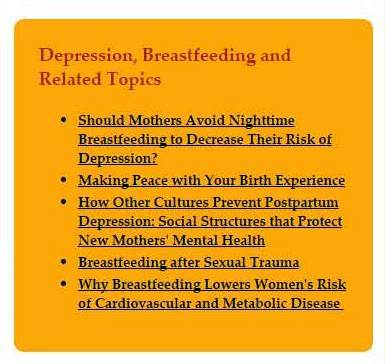
treatments for depressionSee here for FREE handouts on “Depression, Breastfeeding and Related Topics” (topics included in the orange box below)

related topics

Kathleen Kendall-Tackett has also written (or collaborated on) over 17 articles on the Stress-Lowering Effects of Breastfeeding, which you can find here.

On her Postpartum Depression Home Page, there are 2 articles available for access:

Kendall-Tackett, K. A. (2007). A new paradigm for depression in new mothers: The central role of inflammation and how breastfeeding and anti-inflammatory treatments protect maternal mental health. International Breastfeeding Journal, 2:6

New Hampshire Breastfeeding Task Force. A breastfeeding-friendly approach to depression in new mothers: A Curriculum and Resource Guide for Health Care Providers. 2009 Edition.

And there’s more! She’s also published 2 more books:

All of these articles are open access. You are welcome to use, post or share any or all of them. If you would like reprint them, please contact Kathleen Kendall-Tackett  for the actual Word files. 

Free Webinar: Five Behaviors of a Cohesive Team

As Lactation Specialists (and those aspiring to be), we’re always working in teams – whether it’s a hospital team with physicians, nurses and administrators or a community resource team with infant feeding specialists, nutritionalists, craniosacral therapists, occupational therapists, midwives and doulas, or working as a team with a family to help them meet their breastfeeding goals. In point of fact, being able to work as a team is an important, essential and invaluable skill.

Corexcel is offering a free Webinar titled, “Five Behavors of a Cohesive Team.”

corexcel

Corexcel points out that this webinar is, “Based on the best-selling book, Five Dysfunctions of a Team, and developed in conjunction with its author, Patrick Lencioni, we are excited to introduce Five Behaviors of a Cohesive Team. This new assessment-based learning model combines Lencioni’s work with the Everything DiSC model to provide teams with actionable, often eye-opening, insights into their team and its individual team members. The model makes it easier to quickly identify problems and address them.”


“Five Behaviors of a Cohesive Team is designed for intact teams that share responsibility for results. Join us TODAY to see how your team can benefit from this new assessment.”

register

Please note: If the registration link doesn’t work for you, please copy and paste this URL into your browser: https://corexcel.webex.com/corexcel/onstage/g.php?d=668381831&t=a

Lactation Program Review: Certified Lactation Educator (CLE) Training through CAPPA


Lactation Program Review: 

Certified Lactation Educator (CLE) Training Program

through  CAPPA Academy

 Reviewer: Christy Jo Hendricks, IBCLC

        January 20, 2015

How long did it take you to complete the program? 3 months

What year did you complete the program? 2012

Certification or Certificate Offered – Certified Lactation Educator (CLE)

Scope of practice for a Certified Lactation Educator (CLE)

Delivery of Program – In-person 20 hour Lactation Educator Training over a period of 3 days + certification requirements via CAPPA Academy (now completely online).

CAPPA’s current Lactation Educator Training locations, times and dates

Books & Materials Required – The initial three-day training provided a manual and handouts that corresponded with the PowerPoint. After taking the 20 Hour Course, individuals who certify are required to read the manual (provided) and four additional books from this list and one of the following texts in its latest edition: Hale and Hartmann’s Textbook of Human Lactation OR Jan Riordan’s Breastfeeding and Human Lactation (preferred textbook).

Cost of Program (Including books, materials, application fees, etc.) – $400 (early bird) + $55 CAPPA Membership + $35 Hug Your Baby +$175 CAPPA Academy = $665 + cost of 5 additional books.

If you don’t want to be certified and just want to take CAPPA’s 20 hour Lactation Educator Training, then you just pay the cost of the 3 day workshop (usually around $400) and all other materials are provided for free.

# of L-CERPs, Nursing Contact Hours, CEUs, CPEs, etc. offered – 21.5 L-CERPs (guaranteed through 2015).

Do this program’s hours meet partial or full requirements for the IBCLC exam’s lactation specific training requirement?

Yes, partial (21.25 hours).

If yes, how many hours of lactation specific training are counted for the IBCLC exam?

It counts for 21.25 hours towards the 90 hour IBCLC exam lactation education requirement.

Name of trainer(s): Laurel Wilson

What did you like about the program?

  • I was impressed that so much was covered. There were sections on anatomy, physiology, latch, education, curriculum development, business marketing and networking opportunities.
  • I was happy to see the program stressing evidence-based information and autonomy of clients.
  • I also appreciated the organization of the program and the accessibility of the instructor following the course.
  • I was able to learn so much in three days and then follow through to certification with a mentor.

What did you dislike about the program?

At the time I took the course, the certification after the training was completed in paper form and mailed in. Since my certification, they have transitioned to an on-line program, which I think is much better. They now have traditional, distance and accelerated options for those wishing to certify. I appreciate CAPPA staying contemporary in education.

How rigorous/time consuming did you find the program?

Since I was already an IBCLC, I was able to take the accelerated course. I had read the required books and regularly attended coalitions meetings and read research, so, for me, it was not difficult. It fit into my regular schedule. I think the reading assignments and research reviews are probably the most time consuming.

Would you recommend this program to others?

Absolutely! It is a perfect entry level course for those who want to enter the lactation field and it also helps those in the perinatal field to earn a certification for a relatively small investment. It is a recognized certification that can help propel a profession and build breastfeeding education confidence. So many families have questions regarding breastfeeding and I believe every doula, WIC Peer and RN benefits from a course like the CLE training.

Knowing what you know now, would you take this program again? Yes.

Do you feel the course and/or certification helped you obtain your goals?

Yes. I get referrals from the organization and have used the education-specific training to add to my services. Students who I have trained have been hired at WIC clinics, hospitals, Baby Friendly practices and started private practices.

Additional Comments?

  • I appreciate how quickly this organization answered my questions.
  • I value how committed they are to research and education; thus, offering a free annual conference with free CEUs to all members (with membership only $55), it is very affordable to earn the CERPs needed.
  • I also appreciate the faculty’s willingness to travel to locations so students can take a local training. It has been a wonderful experience.
  • I associated so much with the “Love Wins” philosophy of the organization, I applied to be faculty. I have since learned what is expected of faculty.
  • As a mentor, I am required to serve the students, stay up-to-date on research, promote building bridges with all perinatal professionals and network to improve support for breastfeeding families.

Does your program/credential require you to recertify? If so, how long does the credential last and what is required to recertify? Yes, my CLE credential is good for 3 years. I need 15 CERPs to recertify – all of which can be earned at the annual conference, which is FREE to all CAPPA members. You can read more on CAPPA’s recertification process here.

Would you like to write a review of a Lactation Training Program that you’ve taken? If so, don’t be shy! You can access the review form directly from Galactablog. Or directly online via Google Forms here.

**Disclaimer – The views and opinions expressed in this review are those of the author and do not necessarily reflect those of Galactablog. It’s also important to note that these views are not the only source of information about this particular lactation training program. See here for more program details on CAPPA, along with comparison of similar Lactation Training Programs. If you’re interested in Lactation Training Programs that offer a clinical practice component, see here.

DIY Pumping Bras

Living in Lebanon, access to affordable and quality maternity and nursing clothing (and accessories) is almost an impossible feat. Often when we finally find it, it’s expensive or not well-made and we’re not even sure it will last a few washings. Even in the States and around the world, many can’t afford the $40+ a pumping bra can cost. Well, no worries – you can make your own for FREE with just a little bit of time, imagination and an old bra (or in one case, rubber bands). Here are videos demonstrating 3 different ways to make a DYI pumping bra. If you know of other ways, please do share!

1) Using an old sports bra

2) Using a regular bra (offers more support for those who are bigger chested)

3) A nifty rubber band trick using your breast pump

 All 3 videos DYI Pumping Bra are featured here on Galactablog’s Youtube Channel which makes it easy to share and view. Check it out and subscribe so you don’t miss a video.

Interested in DYI options? You can make your own nursing tanks and tops as well! Easy peasy. See Galactablog’s YouTube DYI Nursing Tops channel for more DYI how-to-videos and Galactablog’s “DYI Breastfeeding Hacks” Pinterest Board for more ideas.

Lactation Program Review: Healthy Children’s Lactation Counselor Training Course & CLC Certification

Lactation Program Review: 

Healthy Children’s Center for Breastfeeding’s  

Lactation Counselor Training Course

By Stormy Miller

January 18, 2015

How long did it take you to complete the program? 1 week (Monday-Friday)

Certification or Certificate Offered – Certified Lactation Counselor (CLC)

Delivery of Program – In-person

Books & Materials Required – The Pocket Guide for Lactation Management by Karin Cadwell, 2nd edition (can be purchased on Amazon from about $25-$35). I paid $32.

Cost of Program (Including books, materials, application fees, etc.) – I paid $575 (early bird price) + $120 (application fee and exam fee) +$32 book = $727 total cost

# of L-CERPs, Nursing Contact Hours, CEUs, CPEs, etc. offered – 45 Nursing contact hours, L-CERPs, CPEs; 4.5 CEUs for CNMs

What did you like about the program?

  • The course was Monday through Friday – I could knock it out in 1 week. I took a week off work while my toddler was in daycare so I could finish it quickly. Since I work full-time, I don’t much extra time at home.
  • The course was very comprehensive. I learned a lot of evidence-based information.
  • We were sent home with homework every night, but reviewed it in class the next morning. I was able to keep the majority of it and use it as a study guide. The homework wasn’t too bad – I could still complete it on top of my “wife” and “mom” responsibilities with a 15 month old breastfeeding toddler.
  • During lunch and breaks, we got into groups to complete role-plays.
  • The instructors were very nice and knowledgeable.
  • I was allowed me to pump in the back of the room!
  • With the CLC certification, I can open up a private practice if I wanted to.

What did you dislike about the program?

  • The Training Program was a little rigorous, but it was doable. My personal breastfeeding experience and health science background helped me a lot as well.
  • The Training was a little outdated. It showed a lot of old videos and referenced older studies, which made me wonder if there are in fact, more current studies and videos they could’ve utilized?
  • We didn’t cover anything to do with nursing to sleep and this is a very common question asked by new mothers.
  • The issues of pumping, returning to work and balancing working and breastfeeding were barely discussed, nor was how to give infants bottles in a breastfeeding-friendly way (paced bottle-feeding), which is essential information for a caregiver while mom is away at work. Literally, there were only a few bullet points in the whole book/program. I feel this is a very basic thing that many mothers deal experience and need help with.
  • We were only showed 2 examples of LATCH videos to practice. We definitely need to have more practice for the exam! And I would’ve liked more latch video examples.
  • The instructors told us that there wouldn’t be any questions regarding statistics on the exam, but in fact, there was.

How rigorous/time consuming did you find the program?

Since I work full-time, I did have to arrange to schedule Monday-Friday off. The homework wasn’t too bad, and I was still able to complete with a 15 month breastfeeding toddler at home.

Would you recommend this program to others?

Yes, if someone is interested in lactation, I would say this this is a very good program to start with.

Knowing what you know now, would you take this program again? Yes.

Do you feel the course and/or certification helped you obtain your goals?

Yes. I want to help working mothers and I’m also working with the state coalition with a daycare project.

Does your program/credential require you to recertify? If so, how long does the credential last and what is required to recertify? My CLC credential lasts is good for 3 years. Recertification takes 18 hours of continuing education.

Would you like to write a review of a Lactation Training Program that you’ve taken? If so, don’t be shy! You can access the review form directly from Galactablog. Or directly online via Google Forms here.

**Disclaimer – The views and opinions expressed in this review are those of the author and do not necessarily reflect those of Galactablog. It’s also important to note that these views are not the only source of information about this particular lactation training program. See here for more program details on Healthy Children’s Lactation Counselor Training Course, along with comparison of similar Lactation Training Programs. If you’re interested in Lactation Training Programs that offer a clinical practice component, see here.