Tuesdays Tips & Tricks: Knitted Breastfed Baby Poop Diaper (a.k.a. ‘Happy Knappy’) as a Teaching Tool

Photo courtesy of Philippa Pearson-Glaze, IBCLC (2017) from the website: breastfeeding.support

Do you knit? If not, perhaps you have a friend, neighbor, relative or co-worker that knits? It is definitely worth asking around (and being willing to bribe) if you do not – or perhaps using this as a perfect excuse to learn yourself – because this adorable knitted diaper demonstrating what normal breastfed baby poop looks like for the first 5 days (and in weeks 1-6 postpartum) is a great, effective teaching tool – not only for prenatal breastfeeding classes but also for home and hospital consultations you may be doing soon after birth.

I’m sure many of you have received frantic phone calls from scared, worried parents telling you their baby’s poop is black, green and/or yellow. A visual teaching aid like the ‘Happy Knappy’ not only teaches parents what to expect (and what’s normal) with regards to the color, consistency and size of an exclusively breastfed baby’s poop, but it also is an indicator if babe is getting enough milk or not, babe’s general health and how breastfeeding is going.  See Philippa Pearson-Glaze’s article, “Breastfed Baby Poop” for more detail on what exclusively breastfed baby poop should look like and how to use the ‘Happy Knappy’ as a teaching tool.

Wondering how to knit the ‘Happy Knappy’? La Leche League International has a FREE pattern here.

(courtesy of Alison Blenkinsop, 2014)

Don’t knit yourself? And you don’t know anyone who knits? Have no fear – next Tuesday’s ‘Tips & Tricks’ will feature DIY options that do NOT require any knitting whatsoever. Stay tuned.

Do you have musical talent? Want to make your clients giggle and give them a fun way to remember what normal breastfed baby poop looks like? Try singing the song, “The Five Days of Feeding” while you are demonstrating your ‘Happy Knappy.’

“The Five Days of Feeding” Song

Sung to the tune of “The Twelve Days of Christmas”

On the first day of feeding, your babe will give to you a wee and a sticky black poo.

On the second day of feeding, 
your babe will give to you
two little wees and a less sticky, thinner dark poo.

On the third day of feeding, 
your babe will give to you
three little wees, two little burpsand a big greeny-browny soft poo.

On the fourth day of feeding, 
your babe will give to you four little wees, three little farts, two little burps and a nice runny toffee-brown poo.

On the fifth day of feeding, 
your babe will give to you five bi-ig wees;
four little farts, three big burps, two overflows, and a large golden mustard-seed poo!

(Song from Alison Blenkinsop’s 2008 book Fit to Bust: A Comic Treasure Chest, chapter 5.)

Do you have a tip or trick that you think should be featured on Galactablog? If so, don’t be shy. Please share with me! You can contact me here.

Babies and the Art of Sucking

While completing an online lecture via Lactation Education Resources (LER), Jane Bradshaw, RN, BSN, IBCLC stated something so eloquently in one of her lectures that I couldn’t help but share it with my fellow lacties.

One of the most common questions (and concerns and fears) new mothers consistently have is, “Do I have enough milk? Why does my baby want to suck all of the time? This MUST mean I don’t have enough milk!” This quote not only sums up a baby’s biological need and desire to suckle simply and beautifully but it also empowers a breastfeeding mother to know that yes, she can make enough milk to meet her infant’s needs.

final sucking instinct quote

Photo used with permission. Copyright © 2016 Galactablog and Tamara Drenttel Brand.


How a Simple Candy Dispenser Can Help Teach a Wide, Deep Latch

A shallow latch is more often than not the cause of sore nipples and nipple damage. The importance of a wide, deep latch (mouth open at a 160 degree angle) and chin touching breast first is an important concept to portray to breastfeeding families (and those intending to breastfeed). I am always on the hunt for new and innovative ways to describe this image, particularly when I am trying to troubleshoot over the telephone or working with a mother who speaks English as a Second Language.

Fortunately, Angela Love-Zaranka, BA, IBCLC, RLC, in her “latching and positioning” pez 3lecture for the Baby Friendly Hospital Initiative (BFHI) Nurse, Physician and Staff Training offered by Lactation Education Resources (LER), has provided yet another fantastic tool I can add to my repertoire. It’s simple, brilliant and cheap (and chances are, if you have a little kid at home, it’s free). What is this magic tool you say? It’s a Pez Candy Dispenser. Yes, you read that right!

Angela explains, the “baby’s head looks like a Pez Dispenser coming to the breast helps parents understand the concept of bringing baby’s chin to breast first.” Thanks Angela! Now the fun and most difficult part – picking out which Pez Dispenser you want to use for demonstrations.800px-Hello_Kitty_PEZ_dispenser_open_II

Do you have a nifty trick that makes your life as a lactation specialist (or one aspiring to be) easier? Well, please don’t be shy! Please share it with Galactablog and we’ll share it with all of our loyal followers. Of course, we promise you full credit for your brilliancy. Contact us here or at galactablog{at}gmail{dot}com.


How Can Lactation Professionals Help Make Child Care Centers Breastfeeding-Friendly?

edited stormy cover pic

Guest Post by Stormy Miller, CLC

February 27, 2015

Why should daycares, nurseries and child care centers support their breastfeeding families and create a breastfeeding-friendly site?

In short, the payoff is significant.

Child Care Centers can see savings and benefits from breastfeeding in areas like:

  • Better daily attendancebreastfeeding_welcome_here_stickers
  • Less spit-up, reflux and GERD
  • Less offensive diaper smell
  • Healthier newborns, infants and children
  • Public image boost for center
  • Builds trust and communication with parents
  • Encourages centers and its employees to be up-to-date on current breastfeeding information and practices related to child care and development
  • Centers under the USDA Child Nutrition Program (or similar programs) may get reimbursed if parents do not use the provided food (as they are instead using expressed breast milk)

Having a breastfeeding-friendly daycare, nursery or child care center will not only help support the mother in reaching her breastfeeding goals, but it will also increase breastfeeding rates and lead to healthier people. Hopefully, this in turn will help reach the Healthy People 2020 goals.

How do we create a breastfeeding-friendly center?

  • Education is key! Staff and employees not only need to know the benefits of breast milk but also how to bottle feed breastfed babies (called paced bottle feeding) and how to store and handle breast milk (more on this below). They also need to know that from 1 – 6 months of age, breastfed babies do not need increased quantities of milk because breast milk changes composition to meet infants’ needs – so unlike formula, volume does not increase. Many assume that as babies grow, they need greater quantities of milk and this is not true in the case of breastfed babies.
  • Paced Bottle Feeding – This is a method of bottle feeding that mimics breastfeeding. The baby controls the feeding, just like at the breast, which is not only healthier for the infant’s digestive tract, but it helps protect the breastfeeding relationship. See here for videos on how to do Paced Bottle Feeding.

  • Feed on demand – Watch for hunger cues instead of scheduled feedings. In fact, most infants will begin to put themselves on a general schedule (e.g. 3 oz every 3 hours).
  • Develop a communication plan with parents – What should be done if breast milk is gone? Does mom want to bring in an emergency freezer stash that is clearly labeled for cases like this? When should this freezer bag be de-thawed and does mom want to be contacted in this case? What does mom want done if baby is acting hungry and she will not arrive for another hour? Have a clear plan and be aware of both parties’ expectations.
  • Do not give any bottle within 1 hour of mom’s arrival if possible– This way baby will be ready for mom (as long as this is outlined in communication plan).
  • Know proper breast milk storage and handing guidelines, including  how to properly thaw and warm up breast milk.– see here and here and here.
    • Guideline charts are great to print and put on all of the refrigerators!
  • milk labelsEstablish proper and correct labeling procedures in place for breast milk. Ensure  all staff understand protocol and labeling techniques and that parents are educated on labeling protocol as well.
  • Ask the mother to bring her milk in small amounts (2-3oz. in each bag) to avoid unnecessary wastage – especially if regulations require throwing out bottles that are not finished within 1 hour.
  • Offer to keep breast milk in the mother’s cooler, if her baby has not finished it within the 1 hour rule.
  • Baby-wear – wear infants in wraps, slings, etc. Studies show baby-wearing keeps babies calmer, less colicky, promotes physical development, increases trust and attachment and promotes breastfeeding; in addition to helping employees multi-task with multiple children. See here and here and here. Some cities, counties and or state regulating agencies do not allow baby-wearing, so always check with your regulatory agency first to ensure you are abiding by current regulations.
  • Have free breastfeeding materials and how-to guides available for caregivers here and breastfeeding families here (hard copy), here (electronic) and here readily available and accessible. These are just some examples of what’s available.
  • Create a community breastfeeding resource guide – let parents and caregivers know what type of help is available in their own communities. This can include local breastfeeding support groups, WIC offices, lactation consultants, breastfeeding peer counselors, breastfeeding classes, Baby Cafés, etc.

    Click on book!

  • Normalize breast feeding for all – infants, children, parents, employees, etc. Have children’s books that discuss breastfeeding or show illustrations of breastfeeding. This demonstrates that nursing is the natural and healthiest way of feeding. Some examples available: Mama’s Milk, Nursies When the Sun Shines, The Mystery of the Breast, We Like to Nurse, We Like to Nurse Too, Mommy Breastfeeds My Baby BrotherMichele: The Nursing Toddler – A Story about Sharing Love

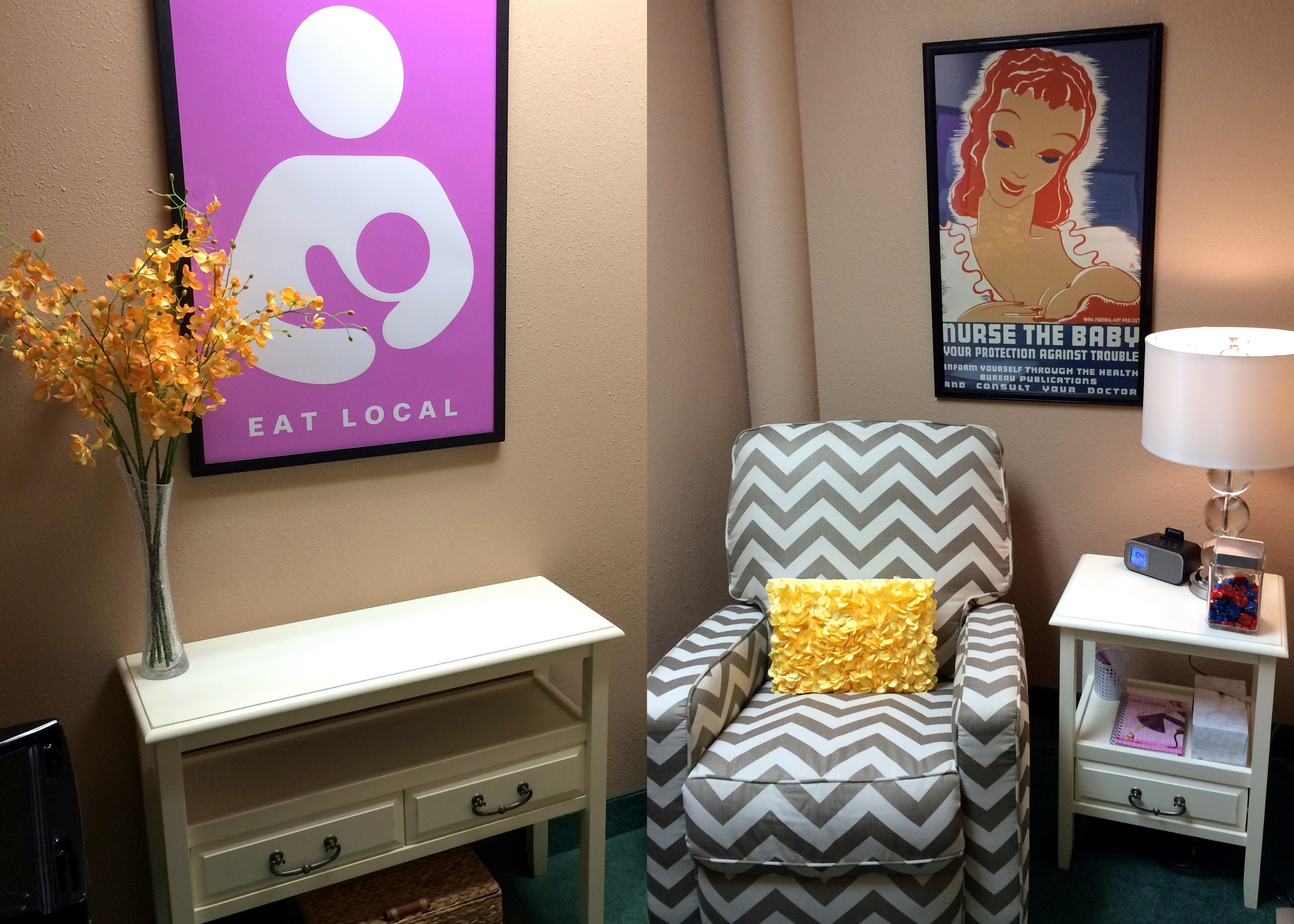
 Last but not least, provide a comfortable, practical space for pumping and nursing – for both nursing mothers, staff and employees. Many mothers will nurse at drop-off and, if their work allows, will pop in during the day to nurse their baby. What can be included in a pumping/nursing space? Here are some ideas: 

ACES Lactation Room, Peoria, AZ http://austincenters.com/

Lactation Room at Austin Centers for Exceptional Students (ACES) Peoria, AZ http://austincenters.com/

  • A room with a locking door, a comfortable chair – perhaps with a footstool, outlet for the pump, table to set the pump on, a mini fridge or fridge access, a sink (or access to one), a CD player or I-pod dock for relaxing music and mini heater for cold rooms can also be beneficial.
  • If possible, a microwave for sanitizing (with the microwave bags). Hand sanitizer and/or sanitizing wipes.
  • Even better – providing extra storage bags and bottles for milk collection in case the mother forgets hers at home.
  • If a workplace has multiple pumpers, they could consider investing in and supplying a hospital-grade multi-user pump. This will enable mothers and staff to pump efficiently and effectively – thus saving time and ensuring they maintain their milk supply. A win-win for all!


If you would like to write a guest post or collaborate on a post for Galactablog, please contact me with your ideas! I am open, flexible and very interested in helping you publish anything lactation-related.

Tongue Tie Educational Video Teaching Tip

This incredibly useful, creative and educational video tip by MaryAnn O’Hara, MD, MPH is excellent for teaching lactation professionals, aspiring lactation specialists, breastfeeding peer counselors and even parents HOW to understand (and teach) tongue tie  what is is, how it can affect breastfeeding and what clipping entails. Dr. O’Hara’s approach is innovative, applicable and brilliant. I must say so myself, it’s quite fun to do as well. But I worn you, it takes a bit of practice, so practice at home in front of a mirror first!

I’d like to note that I heard about this video via Lisa Green, DNP, RN, who mentioned it during one of her lectures that was a part of ASU’s Clinical Lactation Management program.

Do you have any educational videos in mind that you’d like to share? Perhaps one that helps better illustrate a concept or another that has incredible eye-catching graphics. If it relates to lactation, contact Galactablog with your ideas! Also, check out Galactablog’s Youtube Video channel. Breastfeeding-related topics are categorized and arranged as different playlists. Again, if you’d like me to add any videos you find particularly effective, don’t be shy, let me know!

Welcome to Galactablog

Hello-Welcome-Picture

Welcome to Galactablog! Have a look around, make yourself at home. There are lots of free resources: webinars and podcasts, handouts, journal articles, training modules, DYI breastfeeding tips, tricks and products, CERPs/CEUs and more. Topics relevant to lactation will be blogged about and shared – not only by myself, but also by lactation specialists and those aspiring-to-be from around the world.

guest postIf you have a special topic that you’re passionate about – consider writing a Guest Post. I’d love to feature it and of course, give you all the credit. Plus, you’ll have a free opportunity for shameless self-promotion. Send me your ideas here.

Galactablog has some fun weekly series – so keep your eyes out for ‘Freebie Friday,’ ‘Tuesday’s Tips & Tricks,’ ‘Words from the Wise‘ and ‘The Sunday Review.’

Check out Galactablog’s Pinterest Boards and YouTube Channel, both full of social-media-design-concept_1284-5151free breastfeeding-related videos for parents and professionals. All are free resources you can use to further your own lactation knowledge and to help those around you breastfeed. Galactablog is also on Twitter and Facebook, both as a ‘Community Group‘ and a closed, private group open to lactation professionals, those aspiring-to-be and breastfeeding supporters.

If you’re interested in furthering your lactation training, check out the various lactation training opportunities under the “Lactation Training” tab in the header. I’m not in any way affiliated with any of the programs, nor do I earn any money or incentives – I just want to disseminate the information out to those who need it. If you know of a program I’ve left out, please send the info my way so it can be included.

final the sunday review lactation programsGalactablog is the ONLY blog in the world to publish reviews of lactation training programs in the weekly ‘Sunday Review’ series, so for those of you who’ve taken these trainings and/or finished lactation training programs, consider writing a review so we can help others decide what program and will best fit their needs. You can use your name or go anoymous – up to you. You can find the review form here. Lactation programs ARE reading the reviews published and your review can help create change.

I look forward to working collaboratively in order to create FREE resources accessible worldwide to help not only my fellow Lacties, but to help encourage breastfeeding.

Stay tuned for more,
Tamara